Technology Enabled 6Rs Framework for Global Sustainability

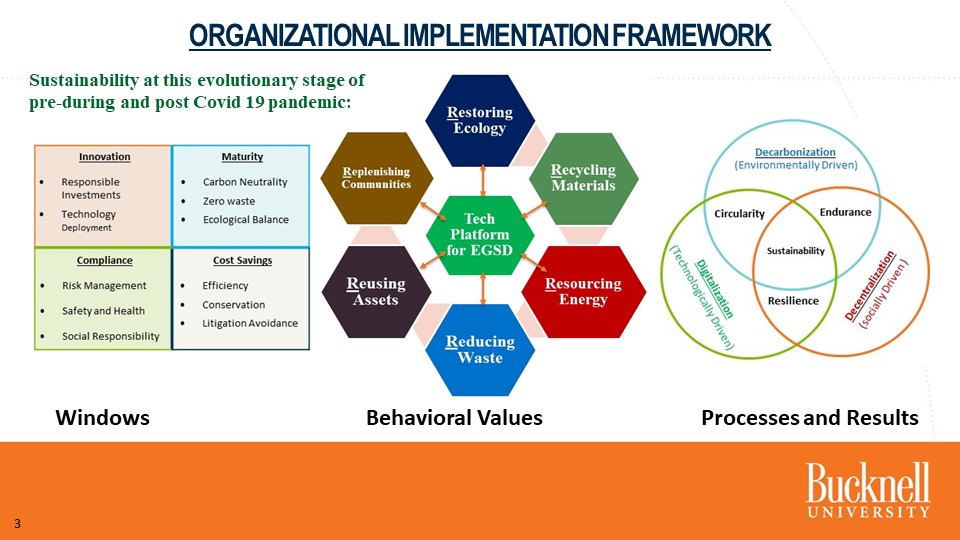
The Covid 19 pandemic, ongoing climate change challenges and the demand for racial justice and equity has resulted in a renewed interest on sustainable development and global sustainability. Progressive organizations are integrating environmental, social and governance (ESG) impact investments, disclosures and reporting into their management for purposeful stakeholders (employees, customers, investors, and other stakeholders) results. Organizations consists of the investors and employees who work effectively with other stakeholders to deliver service to their customers. Employees represent the culture and values of organizations. For any organization to meet their ESG targets, employees must be incentivized to demonstrate sustainability values and behaviors. Bucknell University for instance is integrating diversity, equity; and inclusion (DEI) along with sustainability acumen into employee’s performance appraisal processes.
What behaviors will enable organizations to meet ESG targets and contribute towards global sustainability? This paper presents a framework of behavioral values that will help organizations contribute for equitable global sustainable development (EGSD) and overall sustainability consistent with the people, planet, progress, peace and partnerships (5Ps) of the UN SDGs. The framework will help organizations to drive global sustainability behaviors. It is focused on Reducing consumption, Recycling materials, Reusing assets, Restoring treasures, Replenishing the ecosystem and Resourcing supplies (6Rs). The first three of the 6Rs (reducing, recycling, and reusing) are primarily focused on preservation and waste elimination. The last three (restoring, replenishing, resourcing) are critical to equity and overall EGSD – social sustainability, technological sustainability, and environmental sustainability. Technological sustainability which has to do with the culture of tools, infrastructure, and knowledge utilization to optimize limited global resources for decarbonization with digitalization and decentralization processes will enable implementation of the 6Rs behavioral framework for social sustainability (behaviors and people) and environmental sustainability (planet earth). Continue reading Technology Enabled 6Rs Framework for Global Sustainability

“Beyond Food Deserts: Urban Agriculture for Social Justice and the Case of Washington, DC

For cities looking to create more sustainable food systems, utilizing urban agriculture is an attractive prospect. With the myriad of approaches to urban agriculture, however, understanding the distinct qualities of different agri-food approaches is imperative when deciding which approaches to prioritize and how to conceptualize their respective assets. The literature on urban food security often focuses on urban agriculture without adequate attention to the larger systems in which food is produced and consumed. I build upon existing literature that critiques the urban food movement and draw upon political ecology approaches that look at the deeper patterns and modalities of inequality in urban food systems. This paper contributes a novel typology of the approaches to urban food production and distribution through a critical political ecology lens. It examines the underlying forces of inequality with regard to how those approaches impact across racial and economic lines and considers time scales of those impacts. After establishing the typology of urban food production and analysis, this paper offers a case study of Washington DC The city has been heralded internationally for its approach to addressing food justice (Milan Urban Food Policy Pact, 2019) and still, DC has room for improvement. Centrally, this work argues that innovation and system level change is being achieved in the Washington DC context through individual and organizational initiatives, while significant policy gaps remain.  Continue reading “Beyond Food Deserts: Urban Agriculture for Social Justice and the Case of Washington, DC

The Importance of Ventilation in COVID-19 Transmission

The COVID-19 virus has been a part of everyone’s lives for over a year but there are still many misconceptions about how the virus is transmitted. In this poster we will show educational materials we created that aim to clarify the main transmission method of the virus, which is through respiratory droplets and aerosols. Respiratory droplets (diameter of 10-100 microns) or aerosols (diameter less than 10 microns) come from an infected person’s mouth or nose when they breathe, talk, sneeze, or cough. In a poorly ventilated room, these particles can linger in the air and infect others. In addition to wearing masks properly, ventilation can reduce COVID-19 transmission. Ventilation brings in outdoor air to dilute air particles related to COVID-19, and also other air pollutants and pathogens. Measuring CO2 is one way to estimate how often air is being exchanged in a room, with higher CO2 levels could indicate a low level of ventilation. Students in CEEG 443 measured CO2 cocentrations on and around campus. Our measurements show that ventilation can be improved by opening up windows or by using mechanical ventilation. As the pandemic continues, understanding the power of ventilation and its role in virus transmission is more important than ever. Continue reading The Importance of Ventilation in COVID-19 Transmission

Williamsport: Rivertown Renaissance

At the end of the 20th Century, industrial loss, social changes, and moving to the suburbs had led to small town decline across rural America, including in the Pennsylvania rivertowns. In Williamsport, a major rivertown of the Susquehanna River, we brought people back to town, enhanced community and created a renaissance through art and design. The Main Street Program was the revitalization method we used. Main Street is a program of the National Trust for Historic Preservation designed to save America’s little downtowns and their history.  The Main Street Program consists of four areas of focus: Organization, Design, Economic Restructuring and Promotion. What happened in Williamsport, what our Main Street Program fostered, is part of a national trend of the regionalization of the arts in America. This national trend is helping to create more sustainable communities throughout our nation. Regional arts are participatory. Instead of consuming, we create and we share what we create with each other and the community. Less consumption and more community is creating lifestyle changes that will help us to face the 21st Century challenges of technology, globalization, and climate change. Continue reading Williamsport: Rivertown Renaissance

CO2 Ventilation On Bucknell’s Campus

Carbon dioxide monitors have been used by Professor Sills’ Sustainable Design course to provide information about CO2 levels in different environments on and off of Bucknell’s campus. Carbon dioxide levels can be representative of ventilation in a given area, but also should be examined with caution because they can be affected by other factors. Measuring ventilation is important because of the way that airborne viruses spread through aerosol particles. This is especially important on Bucknell’s campus as ventilation readings can give an indication on the level of risk for spreading COVID-19. The main findings through measuring the carbon dioxide on campus was that ventilation in campus settings was generally pretty good. This is specifically apparent in classrooms, study spaces, and dining halls. Dorm rooms and residential spaces generally had less ventilation and higher CO2 levels compared to educational spaces on campus. This result broadly explains the importance of letting students have the ability to be in-person for class and other campus activities. This result may also explain that the spread of COVID-19 may happen more often in residential spaces. These results could provide insight to potential policy changes in the coming years. Continue reading CO2 Ventilation On Bucknell’s Campus

Regenerative Agriculture on the Bucknell Farm

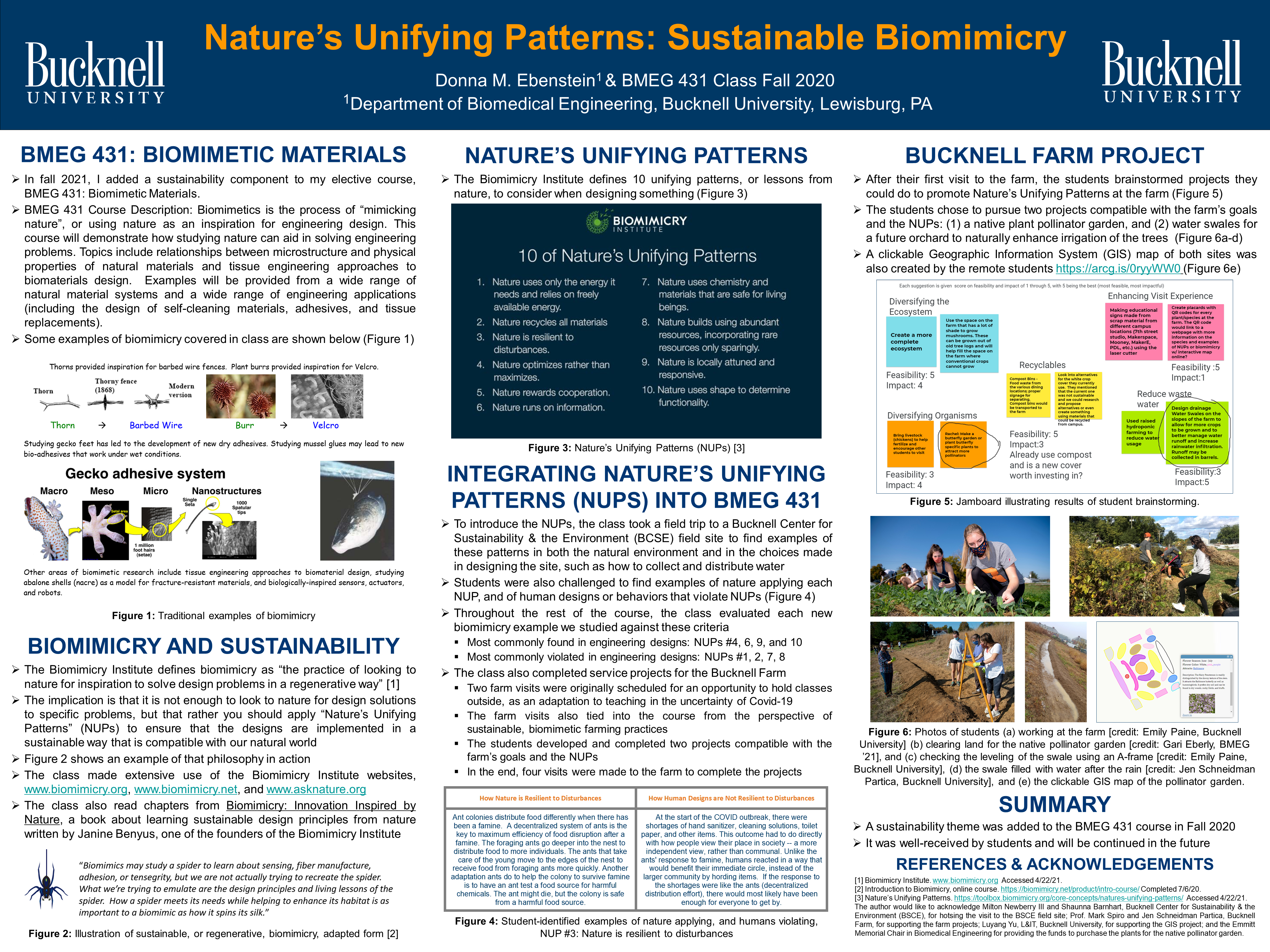
The Bucknell Farm is planning on planting an orchard to cultivate various fruit trees. The proposed location of the fruit trees is on a slope. To prevent runoff of rainwater downslope, the Bucknell Farm would like to implement a form of passive irrigation. Passive irrigation uses water from the environment in contrast to active irrigation which takes water from a municipal source. The Bucknell Farm has already constructed two bioswales, which is a passive method of irrigation that slows down rainwater and allows it to seep into the soil instead of running off. Bioswales consist of a swale and berm. A swale is a long shallow trench from which the soil is removed and piled on the downhill side to create the berm. The trees will be planted in the berm to hold the soil in place and utilize the rainwater that gets absorbed. Professor Deborah Sill’s Sustainable Design Course has been working with the farm to measure soil moisture adjacent to the bioswale and in other parts of the farm to evaluate the effectiveness of bioswales in improving soil moisture. Continue reading Regenerative Agriculture on the Bucknell Farm

Soil Organic Carbon at Bucknell University: Land Management Controls for SOC% and Carbon Sequestration

In this final project for Geomorphology (GEOL316) I used field and lab analysis techniques in combination with peer-reviewed literature to analyze the Soil Organic Carbon% (SOC%) and carbon sequestration found across varying locations on Bucknell’s campus as a result of different types of land management techniques (LM) as well as how they can be adjusted to help the university combat climate change/ carbon emissions. Geomorphology (GEOL316) is an upper level geology class that studies physical processes shaping the Earth’s surface and the evolution of resulting landforms. Soil cores were taken at 0m and 50m along a 50m transect at 4 locations on Bucknell’s campus and a Public Farm with 0m at a higher elevation and 50m at a consecutively lower elevation. These 8 core samples were then analyzed in a lab to calculate Soil Organic Matter% (SOM%)→ SOC% using an approximated conversion factor of 1.72 (DPIRD, 2020). It was found that the highest SOC% found was the 50m core on Bucknell Farm at 5.97% and the lowest SOC% found was the 0m core on the Public farm at 2.97%. The cores taken at the other two field sites (Lawn, Grove) were found to contain SOC% on the lower end of the above range. Bucknell Farm produced the highest SOC% with a LM portfolio of organic N-based fertilizer, deep rooted conscious planting, no-tillage, and winter cover cropping. The Lawn, Grove, and Public farm (P-farm) produced lower SOC% with LM practices of inorganic pellet N-based fertilizer use (Lawn, Grove, P-Farm), non-native monocultured grass lawns (Lawn, Grove), tilling (P-Farm), and overall soil depletion without regenerative or mitigative efforts. The implementation of new LM practices such as the introduction of earthworm populations, reforestation/ agroforestry, conversion from inorganic fertilizer to organic N-based fertilizer, no tillage or reduced tillage, and the replacement of nonnative grass monocultures to native grass polycultures are all suitable and practical methods to increase SOC% across campus and further combat climate change on a University and community wide scale not commonly considered . Continue reading Soil Organic Carbon at Bucknell University: Land Management Controls for SOC% and Carbon Sequestration

A New Tick in Town: Distribution and Density of the Invasive Asian Longhorned Tick (Haemaphysalis longicornis) in Pennsylvania

Since the recent introduction of the Asian longhorned tick (Haemaphysalis longicornis Neumann) in the United States, quantitative surveillance information remains lacking. We conducted statewide, active tick surveillance from May to August 2019 and report data on H. longicornis geographical distribution and population density in Pennsylvania. We collected 615 H. longicornis from four counties. Across samples recovering H. longicornis, mean density of H. longicornis was 9.2/100 m2, comparably greater than Ixodes scapularis Say (8.5/100 m2). Density of H. longicornis was also significantly greater in August, largely driven by larvae, and greater in recreational habitat types (12.6/100 m2) and in Bucks County (11.7/100 m2), situated adjacent to the location of the first U.S. discovery of intense infestations. These data are among the first to document H. longicornis from statewide tick surveillance and provide initial measures of population density enabling more quantitative characterizations of distributional patterns. Continue reading A New Tick in Town: Distribution and Density of the Invasive Asian Longhorned Tick (Haemaphysalis longicornis) in Pennsylvania