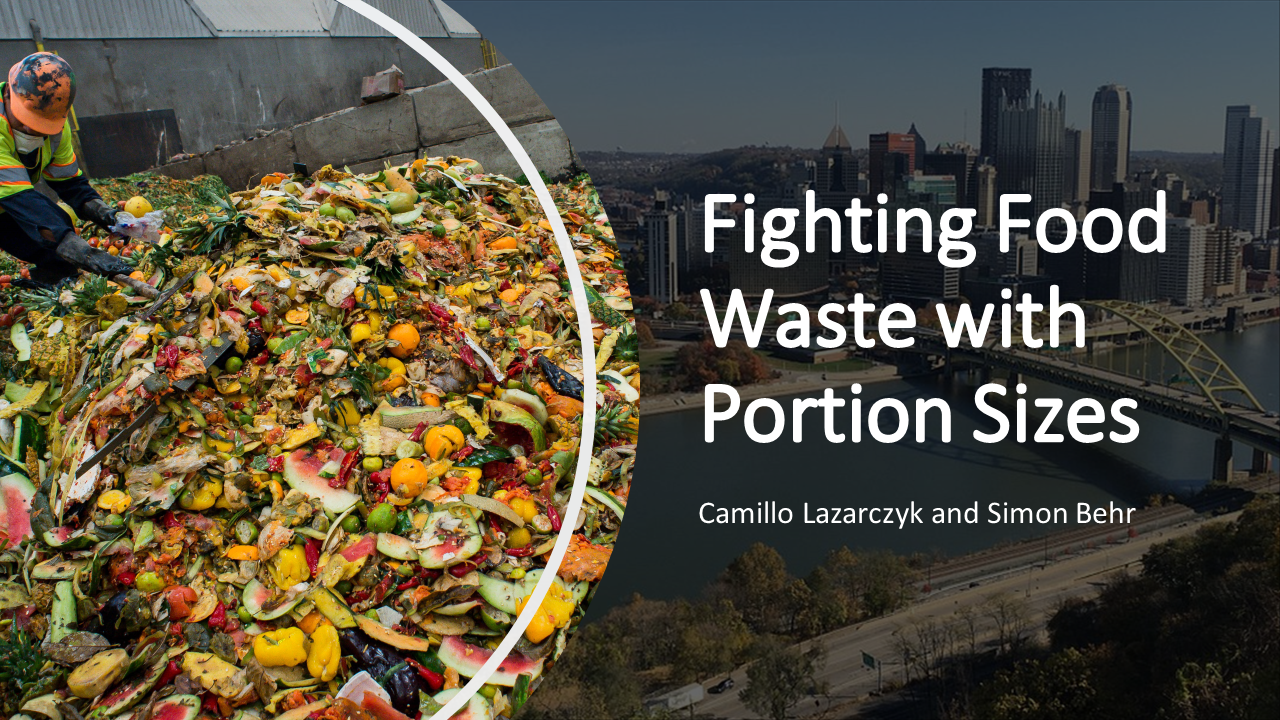
Fighting Food Waste With Portion Sizes

Problem Statement: The US wastes nearly 40% of our food, creating 125-160 billion pounds of waste annually, leading to high emission rates, resource depletion, and food insecurity. Research Question: What are the most effective waste mitigation and management strategies in the restaurant industry that could be utilized to produce a more sustainable environment? A survey administered on campus to classmates to investigate habits, behaviors, knowledge, and potential solutions around food waste yielded significant differences in how much of a meal was thrown out between fast food restaurants, full service restaurants, and buffets. While 25% of respondents throw out 11% or more of their meal at fast food restaurants, the amount of respondents throwing out 11% or more of their meal swells to 37% at full service restaurants. Asked why they throw this food out the most common responses included: Too large portions, ordering too much, inconsistent appetite, and leftovers brought home being thrown out. We deduce the differences are due to one size fits all plates, which are typically over the recommended calorie count. While a variation of small, medium and large sizes are often offered at fast food restaurants, no such options exist at full service restaurants. Males said the portion size of their meal correlated to their appetite 69% of the time but females said the correlation only occurred 57% of the time. Presented with various food waste mitigation strategies respondents were most in favor of the idea of customized menus with multiple portion options. 92% of respondents said they were at least somewhat likely to purchase a smaller portion for less cost. Meanwhile, 55% of respondents are somewhat likely to order smaller food portions for the identical price of the larger meal. Therefor in order to reduce food waste we propose implementing multiple portion options at restaurants. Continue reading Fighting Food Waste With Portion Sizes

Sustainable Residential Microgrid with Permaculture – A Building Block in Sustainable Communities of the Future

Established initially as a research station by the Bucknell University Sustainable Energy Research Team (BUSERT), the microgrid was created to demonstrate off-grid operation of a residential home using the power systems of a PV Array and natural gas generator to supplement typical grid power. Over the past six years the microgrid site has evolved to demonstrate more climate friendly alternatives to energy storage and to demonstrate the benefits of permaculture and organic practices that can be applied in to typical residential settings. The authors share the key elements of the systems employed at the site to decrease it’s carbon footprint overtime and to capture carbon in the process. The technologies include: electric hybrid transportation, photovoltaic array, ultra-high efficiency natural gas heating, load management control via the microgrid Raspberry-Pi, pyrolysis, pollinator gardens, perennial gardens, natural herb gardens and fruit and nut trees, organic compost supplementation and garbage/organics composting, rainwater capture, etc.

During the past few years the site has experienced increases in the insect (particularly bees), amphibian and small mammal populations as the landscape has become increasingly organic in nature. From a technology standpoint the microgrid has operational capability to pull power from the grid, send excess generation to the grid or operate in an islanding mode (without need for the grid). Taken in combination this installation has the ability to operate to minimize costs or to minimize carbon for the homeowner. It represents one small site which now demonstrates multiple ways that homes can contribute to reducing carbon in the future (through reduction in use or sequestering onsite) as well as becoming more self-sufficient in terms of the production of local organic produce for the occupants and their neighborhood. Continue reading Sustainable Residential Microgrid with Permaculture – A Building Block in Sustainable Communities of the Future

A Cross-disciplinary Analysis of Sustainability and Business Performance: Finding New Metrics

At the intersection of the operations management and financial reporting literature, the importance of impact measurement of activities towards operational excellence has long been recognized. Of specific interest are effects on financial performance of continuous improvement frameworks that target quality (e.g. Total Quality Management (TQM), Six Sigma, ISO9000, Corbett et al., 2005, Chatzoglou et al., 2012), cost efficiencies (e.g. Lean Manufacturing) or combinations thereof; but also environmental management systems (EMS, e.g. ISO14001) and on a more systemic scale, the achievement of sustainability, e.g. the United Nation’s Sustainable Development Goals (SDGs) (Mura et al., 2018). Firms that aspire reaching one of more of these SDGs need to establish sustainable initiatives while simultaneously ensuring long-term corporate viability (Elkington, 1994).
With the introduction of ISO 14001 by the International Standards Organization in 1996, firms receive certification when achieving appropriate Environmental Management Systems – a stepping stone towards systemic sustainability initiatives. One of the benefits of ISO 14001 implementation – besides improved environmental performance – could be improved financial performance, through higher efficiency, less waste, and market signaling (Johnstone and Labonne, 2009). However, the evidence in the literature is inconclusive. Klingenberg, Timberlake, Geurts, and Brown (2013), argued and to a certain account showed, that this could be the result of using the wrong metrics. This follow-up research by Klingenberg, Geurts and a Bucknell student, Bryan Scutari, supported by a generous grant of the Institute of Management Accountants, is now exploring better metrics to measure the impact of ISO 14001 on the financial performance of firms. This oral research presentation discusses the historical development of ISO 14001, analyzes how the implementation of ISO 14001 affects the financial performance of firms, and how that results in the development of appropriate metrics. Continue reading A Cross-disciplinary Analysis of Sustainability and Business Performance: Finding New Metrics

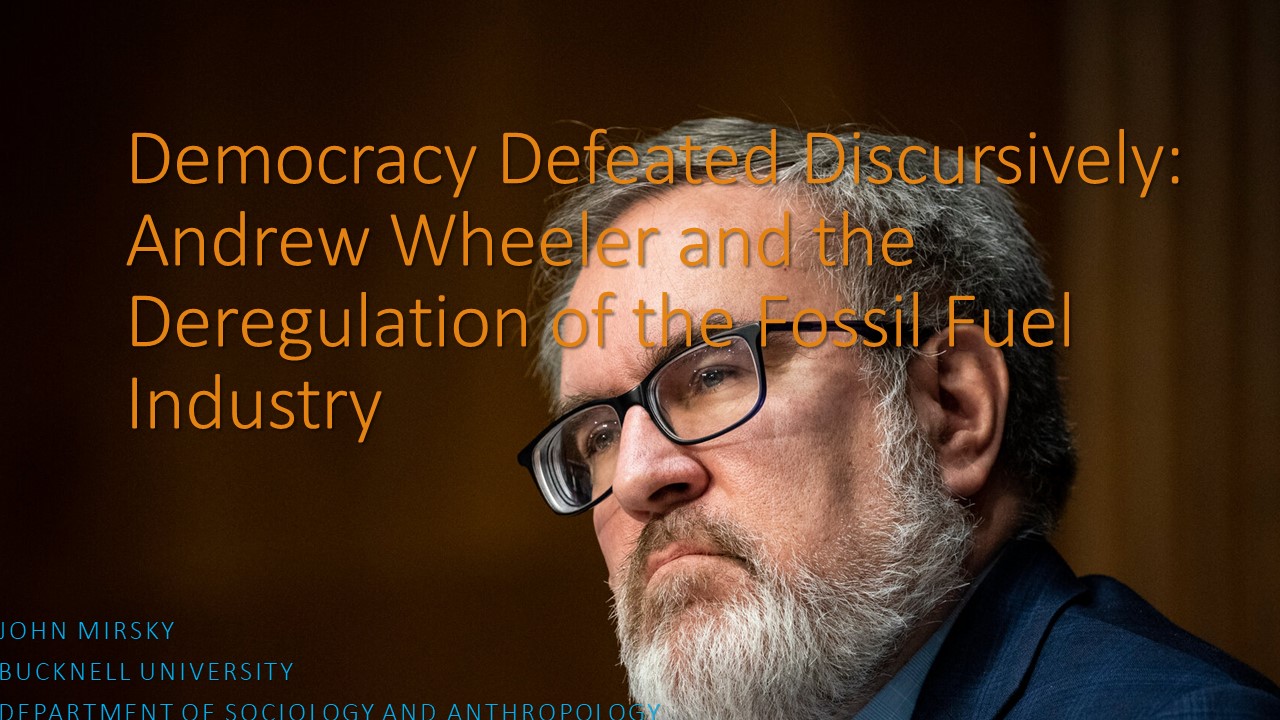
Democracy Defeated Discursively: Andrew Wheeler and the Deregulation of the Fossil Fuel Industry

With over 70% of the U.S. population believing that climate change is a serious problem that merits immediate confrontation, it is both surprising and a serious ecological threat that the Environmental Protection Agency (EPA) furthered over 50 deregulatory actions during the Trump Presidency. While previous research has mostly focused on large economic models and social structures, this project takes a semiotic approach in addressing the issue by analyzing the speech of former EPA administrator Andrew Wheeler in its relationship with this outcome. Through a detailed content analysis of a 3-hour confirmation hearing and a 10-minute news interview, I analyze how Wheeler strategically employs specifically-indexed terms in a way characterized by Aaron Stibbe’s forms of erasure. Findings reveal that Wheeler utilizes all three of Stibbe’s forms of erasure to highlight the import of certainty and other neoliberal tenets in an attempt to align his deregulatory agenda with these tenets. The void-form is most prevalent, indicative of the lack of resistance met by Wheeler in congress. These actions of Wheeler make difficult the possibility of regulatory action in congress, where neoliberalism has been shown to be highly prized. Frequency analyses find that the term certainty is utilized frequently by Wheeler. In light of such findings, it may be fruitful to analyze the speech of other government officials through this lens to allow for meaningful praxis. Continue reading Democracy Defeated Discursively: Andrew Wheeler and the Deregulation of the Fossil Fuel Industry

Technology Enabled 6Rs Framework for Global Sustainability

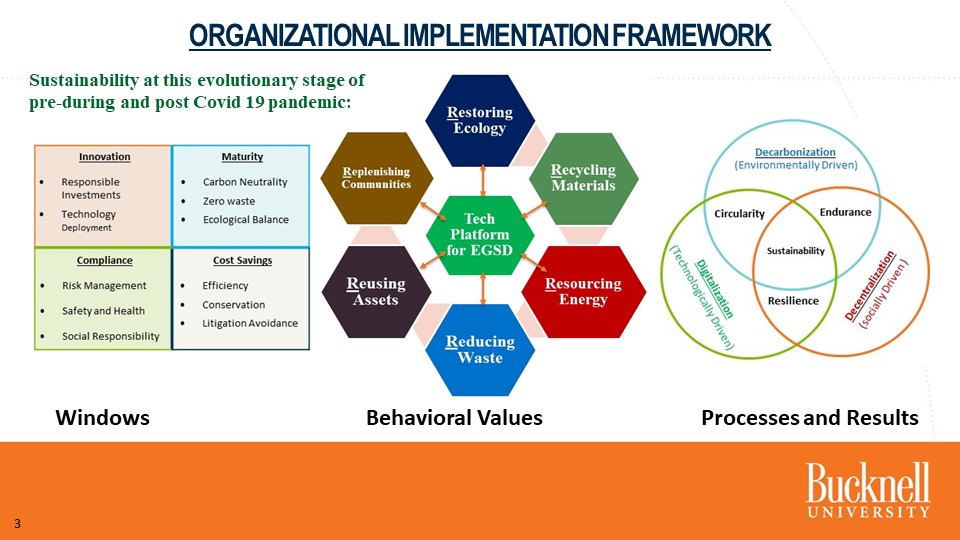
The Covid 19 pandemic, ongoing climate change challenges and the demand for racial justice and equity has resulted in a renewed interest on sustainable development and global sustainability. Progressive organizations are integrating environmental, social and governance (ESG) impact investments, disclosures and reporting into their management for purposeful stakeholders (employees, customers, investors, and other stakeholders) results. Organizations consists of the investors and employees who work effectively with other stakeholders to deliver service to their customers. Employees represent the culture and values of organizations. For any organization to meet their ESG targets, employees must be incentivized to demonstrate sustainability values and behaviors. Bucknell University for instance is integrating diversity, equity; and inclusion (DEI) along with sustainability acumen into employee’s performance appraisal processes.
What behaviors will enable organizations to meet ESG targets and contribute towards global sustainability? This paper presents a framework of behavioral values that will help organizations contribute for equitable global sustainable development (EGSD) and overall sustainability consistent with the people, planet, progress, peace and partnerships (5Ps) of the UN SDGs. The framework will help organizations to drive global sustainability behaviors. It is focused on Reducing consumption, Recycling materials, Reusing assets, Restoring treasures, Replenishing the ecosystem and Resourcing supplies (6Rs). The first three of the 6Rs (reducing, recycling, and reusing) are primarily focused on preservation and waste elimination. The last three (restoring, replenishing, resourcing) are critical to equity and overall EGSD – social sustainability, technological sustainability, and environmental sustainability. Technological sustainability which has to do with the culture of tools, infrastructure, and knowledge utilization to optimize limited global resources for decarbonization with digitalization and decentralization processes will enable implementation of the 6Rs behavioral framework for social sustainability (behaviors and people) and environmental sustainability (planet earth). Continue reading Technology Enabled 6Rs Framework for Global Sustainability

“Beyond Food Deserts: Urban Agriculture for Social Justice and the Case of Washington, DC

For cities looking to create more sustainable food systems, utilizing urban agriculture is an attractive prospect. With the myriad of approaches to urban agriculture, however, understanding the distinct qualities of different agri-food approaches is imperative when deciding which approaches to prioritize and how to conceptualize their respective assets. The literature on urban food security often focuses on urban agriculture without adequate attention to the larger systems in which food is produced and consumed. I build upon existing literature that critiques the urban food movement and draw upon political ecology approaches that look at the deeper patterns and modalities of inequality in urban food systems. This paper contributes a novel typology of the approaches to urban food production and distribution through a critical political ecology lens. It examines the underlying forces of inequality with regard to how those approaches impact across racial and economic lines and considers time scales of those impacts. After establishing the typology of urban food production and analysis, this paper offers a case study of Washington DC The city has been heralded internationally for its approach to addressing food justice (Milan Urban Food Policy Pact, 2019) and still, DC has room for improvement. Centrally, this work argues that innovation and system level change is being achieved in the Washington DC context through individual and organizational initiatives, while significant policy gaps remain.  Continue reading “Beyond Food Deserts: Urban Agriculture for Social Justice and the Case of Washington, DC

Williamsport: Rivertown Renaissance

At the end of the 20th Century, industrial loss, social changes, and moving to the suburbs had led to small town decline across rural America, including in the Pennsylvania rivertowns. In Williamsport, a major rivertown of the Susquehanna River, we brought people back to town, enhanced community and created a renaissance through art and design. The Main Street Program was the revitalization method we used. Main Street is a program of the National Trust for Historic Preservation designed to save America’s little downtowns and their history.  The Main Street Program consists of four areas of focus: Organization, Design, Economic Restructuring and Promotion. What happened in Williamsport, what our Main Street Program fostered, is part of a national trend of the regionalization of the arts in America. This national trend is helping to create more sustainable communities throughout our nation. Regional arts are participatory. Instead of consuming, we create and we share what we create with each other and the community. Less consumption and more community is creating lifestyle changes that will help us to face the 21st Century challenges of technology, globalization, and climate change. Continue reading Williamsport: Rivertown Renaissance

Soil Organic Carbon at Bucknell University: Land Management Controls for SOC% and Carbon Sequestration

In this final project for Geomorphology (GEOL316) I used field and lab analysis techniques in combination with peer-reviewed literature to analyze the Soil Organic Carbon% (SOC%) and carbon sequestration found across varying locations on Bucknell’s campus as a result of different types of land management techniques (LM) as well as how they can be adjusted to help the university combat climate change/ carbon emissions. Geomorphology (GEOL316) is an upper level geology class that studies physical processes shaping the Earth’s surface and the evolution of resulting landforms. Soil cores were taken at 0m and 50m along a 50m transect at 4 locations on Bucknell’s campus and a Public Farm with 0m at a higher elevation and 50m at a consecutively lower elevation. These 8 core samples were then analyzed in a lab to calculate Soil Organic Matter% (SOM%)→ SOC% using an approximated conversion factor of 1.72 (DPIRD, 2020). It was found that the highest SOC% found was the 50m core on Bucknell Farm at 5.97% and the lowest SOC% found was the 0m core on the Public farm at 2.97%. The cores taken at the other two field sites (Lawn, Grove) were found to contain SOC% on the lower end of the above range. Bucknell Farm produced the highest SOC% with a LM portfolio of organic N-based fertilizer, deep rooted conscious planting, no-tillage, and winter cover cropping. The Lawn, Grove, and Public farm (P-farm) produced lower SOC% with LM practices of inorganic pellet N-based fertilizer use (Lawn, Grove, P-Farm), non-native monocultured grass lawns (Lawn, Grove), tilling (P-Farm), and overall soil depletion without regenerative or mitigative efforts. The implementation of new LM practices such as the introduction of earthworm populations, reforestation/ agroforestry, conversion from inorganic fertilizer to organic N-based fertilizer, no tillage or reduced tillage, and the replacement of nonnative grass monocultures to native grass polycultures are all suitable and practical methods to increase SOC% across campus and further combat climate change on a University and community wide scale not commonly considered . Continue reading Soil Organic Carbon at Bucknell University: Land Management Controls for SOC% and Carbon Sequestration